Author: My Joyful Child

  • 7 Natural, High-Magnesium Foods for Kids (That Restored My Daughter After a Deficiency)

    Medical Disclaimer: I am a mother sharing our family’s personal nutritional journey and research, not a medical professional. The information below is for educational and awareness purposes only. Always consult your pediatrician before introducing new supplements or making major changes to your child’s diet.


    Following my 12-year-old daughter Alexandria’s emergency stabilization on an IV drip, our mission as a homeschool family instantly shifted to the kitchen. The big question was: How do we rebuild her mineral reserves in a quality, safe, fun, and highly enjoyable way?

    With prayerful guidance, I entered into in-depth research, weighing our options, and navigating the realities of financial limitations, my husband and I came to a profound realization: whole, raw foods from God’s earth are far safer, more sustainable, and more economical than commercial nutritional shakes.

    Out of the scarcity caused by a devastating hurricane and the trial of a severe household flu, the Lord supernaturally provided us with an abundance of knowledge. We learned exactly how mineral deficiencies may affect a child’s body, and how to safely build a vibrant recovery using natural foods and a few carefully selected supplements.

    Here are the natural, high-magnesium staples that brought the joy, energy, and strength back to our children.


    🥥 1. Liquid Gold: Coconut Water for Constant Hydration

    We discovered that coconut water is a natural electrolyte powerhouse. It rapidly replaces lost fluids during acute illnesses while delivering high amounts of natural potassium and magnesium. 

    • Our Routine: We serve fresh coconut water approximately three days a week right after breakfast or at lunch. It is incredibly refreshing and helps prepare and protect the children’s bodies for hot, dry days. 
    • The Flu Defense: When the children caught the flu again during a recent summer holiday, we used coconut water alongside TrueJuice apple juice as their main beverage. Crucially, we gave Alexandria a glass right at night to keep her electrolytes perfectly balanced while she slept—preventing the terrifying nighttime grunts and disorientation we experienced during her first scare. It worked beautifully, and the children loved it. 
    • Overcoming Anxiety at the Park: Following her initial ordeal, my maternal instinct noticed that Alexandria became timid and hesitant about going out to the park. She wouldn’t say it outright, but she was quietly deeply concerned that running around would leave her too tired or trigger another bodily contraction. To comfort her and keep her safe, we started filling her personal water bottle with coconut water to sip while on the road. It kept her electrolytes intact, balanced her blood sugar, and gave her the confidence to play freely again. 

    (Note: Additionally, we prioritize keeping standard Oral Rehydration Salts (ORS) at home as a secondary line of defense to top up their hydration before long days on the road or to get them back on track on exceptionally hot days). 


    🎃 2. Refrigerator-Dried Pumpkin Seeds (The “Pistachio” Trick)

    Pumpkin seeds are one of the single highest plant-based sources of magnesium on the planet. Because we regularly feature pumpkin on our breakfast menu, we stopped throwing the seeds away and turned them into a savory, fun snack. 

    • How to make them: We wash the raw seeds, spread them out as much as possible on a tray, and place the tray directly into the refrigerator to dry for just a day or two. (Don’t leave them longer or they will dry out too much!). 
    • How to eat them: Alexandria loves having these as a mid-morning or late-afternoon snack while reading or chatting with her little sister. She simply cracks open and peels away the outer white shell to eat the green nut inside. Eaten completely raw, they retain 100% of their nutritional benefits and taste remarkably like delicious pistachio nuts! 

    🍌 3. Mid-Morning Banana Snacks

    On average, Alexandria eats 3 ripe bananas a week as her mid-morning fruit snack. Bananas are a fantastic, accessible source of magnesium, vitamin B6, and potassium, making them an easy win for busy homeschool days. 


    🥔 4. Caribbean Ground Provisions & Green Leafy Greens

    For breakfast, we regularly rotate traditional ground provisions to serve as our healthy starches: 

    • Green Bananas & Ripe Plantains: These serve as excellent, gentle, and easily digestible sources of essential nutrients. 
    • Irish Potatoes & Sweet Potatoes: Comforting carbohydrates that naturally absorb vital minerals directly from the soil.
    • We serve these alongside nutrient-dense proteins like sardines, corned beef, eggs, or chicken. 

    The Dinner Green Challenge: While green leafy vegetables are a dinner priority, getting children to swallow slippery spinach can be a challenge. To keep things economical and kid-friendly, we use callaloo and lettuce as affordable, daily options alongside broccoli (which is their absolute favorite, highly nutritional vegetable treat!). 


    🥛 5. Whole Milk, Dark Chocolate, & Sunday Treats

    As soon as the flu passed, we safely reintroduced whole milk into our mornings as a warm, comforting beverage with Swiss Miss chocolate and chocolate-marshmallow mixes. Pure dark chocolate is another wonderful, joy-filled source of magnesium. 

    • Our Sunday Family Tradition: On Sunday mornings, before our early church service, the children get a special treat: Chips Ahoy! Chunky Fudgy chocolate chip cookies paired with 100% cow’s milk mixed with Swiss chocolate. This provides a fantastic, happy boost of both calcium and magnesium to start the week. 
    • Ice Cream Therapy: We even used ice cream as a joyful, nutrient-dense treat to help bring calcium back into her diet in a way that made her smile every single time. 

    🧪 6. Understanding the Magnesium-Calcium Connection

    During our follow-up care, our pediatrician explained a vital medical fact that completely changed how I looked at nutrition: Magnesium needs Calcium, and Calcium needs Vitamin K2 to absorb correctly. 

    Originally, we thought Alexandria only had low calcium. However, the doctor explained that when a child’s magnesium drops dangerously low, the body will physically pull calcium out of the bones and system to try and supplement the missing magnesium. This causes both numbers to crash. To heal fully, you must restore both minerals in tandem to achieve perfect nutritional balance. 


    💊 7. Sourcing Clean, Liquid Supplements

    To ensure her daily intake numbers perfectly hit pediatric requirements for her age, we decided to combine her whole-food diet with specialized liquid supplements. This combination would facilitate all our children who are currently changing their teeth and growing rapidly every single day, meaning their bodies require an abundance of structural support. 

    With our pediatrician’s affirmation and a goal to retake her blood panel in a few months, we researched and settled on three clean, high-quality choices that can easily be ordered online: 

    1. Osteocare Liquid Calcium Original (with Vitamin D3 & Zinc) 
    2. MaryRuth’s Vegan K2 (MK7) Organic Liquid Drops 
    3. NovaFerrum Yum 16 Fl Oz Multivitamin with Iron (Raspberry Grape flavor for targeted iron support) 

    We specifically chose these because liquid forms are significantly more economical, easier for a child to ingest than bulky pills, and much tastier—which keeps the process completely stress-free. 

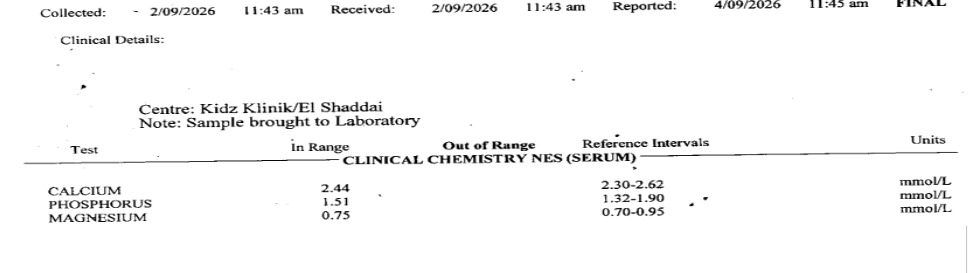
    Alexandria took these regularly for about six months (from February to July). We then intentionally paused the supplements for a few weeks both in March and August, relying solely on her natural whole-food diet, so we could get an accurate, unmasked reading on her follow-up blood tests both in March and early September.  Both her siblings, her eight year old younger sister and ten year old younger brother also took the supplement (to a lesser extent).

    The final results of the latest blood test came back absolutely beautiful—proving that a dedicated kitchen strategy works and the deficiency is fully resolved! 

    🙅‍♀️ Why We Permanently Abandoned Commercial Nutritional Shakes

    When we first brought Alexandria home, we initially bought PediaSure Grow & Gain as a daily supplement. However, after four months of drinking an 8oz bottle almost every day, she grew completely tired of the heavy, clawing taste. 

    More importantly, we noticed her 10-year-old brother started developing an allergic reaction in his sinuses, making congested sounds he had never been accustomed to making. To be absolutely sure of the cause, we ran a test: we took him off the shake, and the sounds stopped. We put him back on, and the reaction returned. 

    By taking him off permanently, his allergies vanished completely. This experience proved to us that real, raw, whole foods are always a parent’s ultimate safe haven. 
  • Hidden Signs of Magnesium Deficiency in Kids: What Every Parent Needs to Know

    Medical Disclaimer: I am a mother sharing our family’s personal medical journey and research, not a doctor. The information below is for educational and awareness purposes only. Always consult your paediatrician or seek emergency medical care if you suspect your child is facing a medical emergency.


    As a homeschool mother of three, I am blessed to be in a position to closely monitor my children’s daily habits, moods, and health. Yet, late last year, my 12-year-old daughter, Alexandria, began displaying a series of unusual symptoms. What started as subtle, easily dismissed signs eventually spiralled into a frightening medical emergency.

    By the grace of God, and through faith and courage, our daughter is doing beautifully today. I am sharing our story because, had someone told me what those subtle warning signs meant before the crisis hit, we would most likely not have had that horrifying experience. If you are a parent looking for answers, I want you to know that you can recognise these signs early—and even if you are already in the middle of a scare, your child can fully recover and live a joyful life again.


    🌪️ The Hidden Catalyst: How Diet Disruptions Impact Minerals

    Looking back, our journey actually began in October of last year when Hurricane Melissa devastated Jamaica’s agriculture and western region. In the months leading up to the Christmas holidays, our local food supply changed drastically.

    Fresh green and ripe bananas, ripe plantains, and green leafy vegetables suddenly vanished from our table. Eggs became incredibly scarce, and potatoes were far too expensive. Without realising it, our family’s diet became heavily limited in vital, raw earth minerals.

    Shortly after, a physical sign appeared. When we visited the park, Alexandria suddenly struggled to jump or play hopscotch. She complained of pain in her knees, and I physically had to hold and support her just so she could jump.


    🤒 The Perfect Storm: Flu, Dehydration, and Deficiencies

    Next, during the Christmas holidays, the flu swept through our household. As a parent, you do everything to separate your children but, sharing rooms and being playmates, make total isolation nearly impossible. One by one, our children fell ill.

    When Alexandria caught the virus, she developed a fever, cold, and vomiting. To help her body fight the illness, we made a common decision to cut dairy entirely out of her diet.

    Unwittingly, we were entering a perfect storm:

    1. Her mineral intake was already low due to the post-hurricane food scarcity.
    2. The flu and vomiting rapidly depleted her hydration.
    3. Removing milk cut off her primary source of calcium, which works hand-in-hand with magnesium.

    🔍 6 Subtle Signs of Low Magnesium We Missed in Real-Time

    In retrospect, my daughter’s body was flashing warning signs for days. These are the symptoms that were evident:

    1. Persistent Trouble Sleeping & Grunting

    Alexandria suddenly began having severe trouble sleeping, which was highly unusual for her. One night she just was not falling asleep. I cuddled and sang for her as I usually would when she needed comforting. Once she eventually fell asleep, I noticed she made persistent, low grunting sounds that lasted throughout the night. I just wasn’t sure what that was.

    2. Physical Contractions in the Extremities

    One morning, Alexandria woke up and said, “Mama, look! My thumbs. My toes. They are contracting.” Her thumbs and big toes were visibly locking up.

    3. Deep Disorientation Upon Waking

    At night, she would wake up seemingly unaware of her surroundings. During one terrifying evening, she woke from a rest and looked right at me, unable to recognise who I was. I had to repeatedly ask her, “Who are you? Who am I?” until she came around, confused as to why I was questioning her.

    4. Cold Limbs and General Somberness

    Even under sheets, her arms and legs felt cold to the touch. Her normal, cheerful personality shifted into a heavy, somber countenance.

    5. Delayed Cognitive Processing

    For a few days leading up to the emergency, she seemed noticeably slower than usual in understanding and getting through her daily homeschool lessons.

    6. Skin Tone Tinting

    It wasn’t until the entire experience was over that I realized her face had developed a distinct, lightly darkened tint, alongside dark circles to the sides of her eyes.


    🧂 The 12-Hour Rehydration Window

    The few mornings her toes and thumbs contracted, we instinctively turned to Oral Rehydration Salts (ORS). we would mix 500 ml of water with a half-packet of the mixture, ensuring she never had more than one full packet in 24 hours.

    Like clockwork, the moment she drank the mixture through a straw, the visible contractions stopped. However, I noticed a strange pattern: exactly 12 hours later, the effects of the mixture would wear off, and the cold limbs, disorientation, and grunting would return.

    We waited until three days in the flu, then took her in to our regular paediatrician. However, our concerns were unfortunately passed off as “strange symptoms accompanying this season’s flu.” Because she wasn’t actively vomiting in his office or visibly displaying any of the other symptoms, we were denied an intravenous (IV) drip for hydration and sent home with standard antibiotics and cold medication.


    🚨 The Emergency Room Crisis

    As we were still unsure about the cause of the symptoms, we were still in assessment mode. The very next day, when the rehydration salts wore off completely, Alexandria went to the bathroom and immediately, and even more aggressively than before, her entire body began violently contracting from her extremities inward. This was a sure sign to me that this was more than strange symptoms accompanying the flu. It was sure that whatever it was, it was advancing.

    Displaying incredible courage, she instructed me exactly what to do: “Place your fingers in my hands, Mama, to stop them from locking up.” Sensing the urgency, her younger siblings beautifully stepped in. They quickly mixed the rehydration salts, brought the cup to her mouth, and held the straw so she could swallow.

    Next, we rushed her to the Emergency Room. Because the rehydration salts temporarily stopped the visible contractions, we were categorised as a non-urgent case. We waited from 3:00 PM until 11:00 PM. During that long wait, the final dose of rehydration salts wore off, and she suffered another terrifying contraction episode right at the moment they were finally putting her on the drip.


    📊 The Blood Test Results: What Parents Need to Know

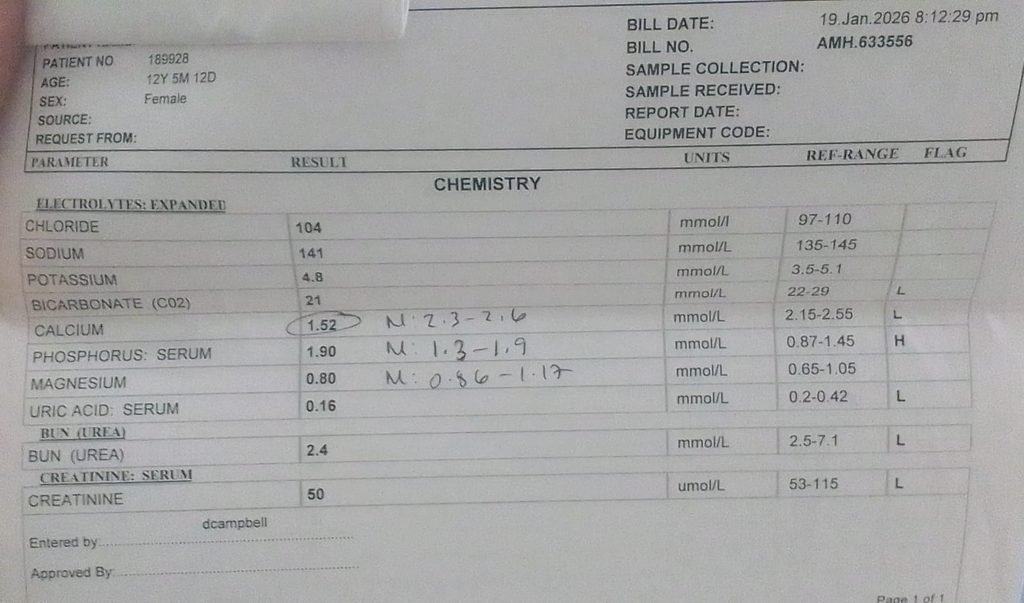
    Once Alexandria was finally placed on an IV drip, the doctors also ran a comprehensive blood metabolic panel. Once the IV fluids safely stabilised her system in the ER, the frightening body contractions vanished completely and have never returned, by the grace of God.

    A Crucial Note for Parents: As this Emergency care was done at a hospital, the readings were done against adult ranges. Children’s healthy mineral ranges differ significantly from adult ranges on lab reports. Always ask your doctor to evaluate the numbers specifically against paediatric benchmarks, rather than standard adult baselines.

    Later on, sometime after the flu had passed, we followed up with our paediatrician, and the culprit was revealed: calcium deficiency. (See report above)


    At that same visit to the paediatrician in March, we did a follow-up test for Alexandria and the other children, now that they had cleared the flu, as well as had some discussions about supplement. The results above show that her calcium had corrected but her magnesium, the true culprit, was now out of range (See report above).

    The paediatrician explained that it was actually her magnesium that was low, and that when this happens, the body pulls calcium to supplement the low magnesium. This is why her calcium also appeared low initially. Therefore, it was vital to increase both to their proper values to ensure correct nutritional balance.

    🥑 Turning the Corner: Our Daily Mineral Menu

    To ensure her levels remain safe and to restore her natural calcium and magnesium balance, we completely overhauled our family kitchen. If you are looking to naturally boost your child’s mineral levels, here are the staples we now include weekly:

    • Raw Pumpkin Seeds: Exceptionally high in natural magnesium.
    • Fresh Coconut Water: Packed with natural electrolytes and potassium.
    • The Return of Greens: Green bananas, ripe bananas, potatoes, and dark leafy greens.
    • Whole Milk & Ice Cream: Reintroduced safely to restore her vital calcium levels.

    (Note: We initially tried commercial nutritional shakes, but our daughter quickly grew tired of the taste, and our son eventually developed an allergic reaction to them, proving that whole, raw foods are always the safest path).

    🤍 A Message of Hope for Frightened Parents

    Even though, subsequent to the event, we had given thanks for Alexandria’s recovery and spoken about it a little bit together as a family, initially revisiting this trauma was a somewhat surprisingly still daunting task, but with prayerfulness, faith, and God’s grace, it got so much better.

    Additionally, as I prayed, the Lord reminded me of how many precious families can be saved if they learn to recognise these subtle symptoms early. If your child is showing unusual signs, listen to your instinct. Trust what you see. And take comfort in knowing that your child can fully recover, your home can find its peace, and your family can live joyfully once again.